BY PEET VAN BILJON

The creativity needed to come up with innovative new ideas relies on novel connections being made in our brains, and on people having the courage to share their ideas with others. Think of it as depending two types of connections: first within the individual brain, and second between many brains within the organization and even beyond organizational boundaries. Both types of connection can be surprisingly hard to make in the face of individual and organizational challenges. Understanding how the human brain handles creativity will help you to overcome these challenges.
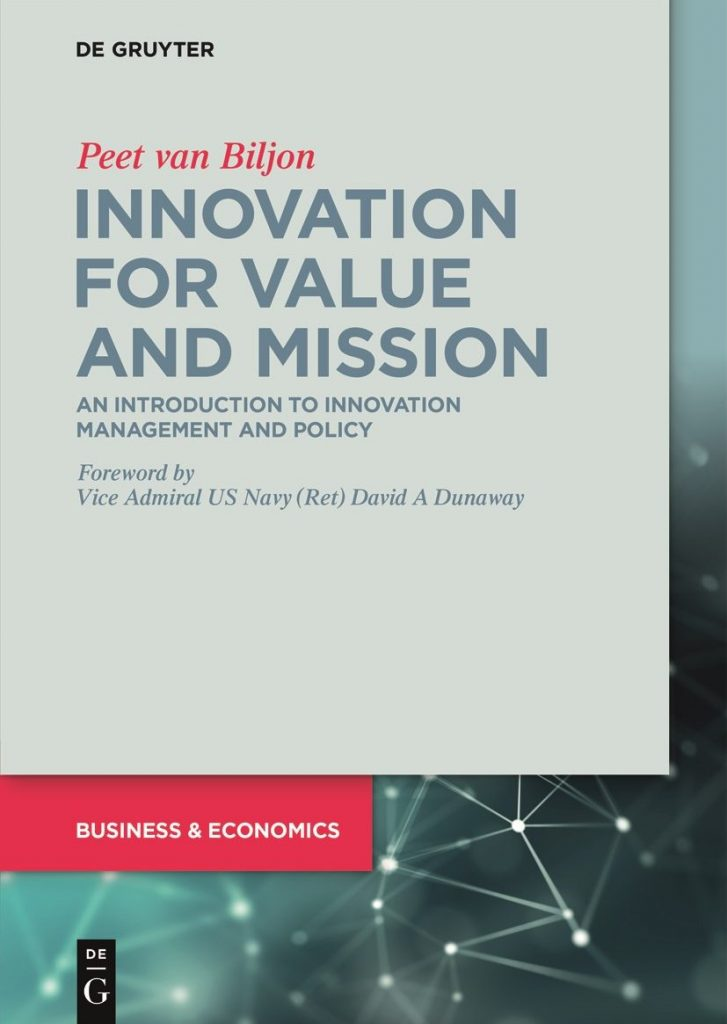
The following is an extract from Chapter 4 of my book, Innovation for Value and Mission – An Introduction to Innovation Management and Policy, published by De Gruyter Brill.
Creativity and the Human Brain
Creativity in business has been much in vogue the last couple of decades. No doubt it is partly influenced by the ascendancy and prevalence of the design-thinking movement since the turn of the century, and the importance which creativity has in that process. But it is perhaps also because there is a belief that human creativity is now better understood and, therefore, can be more easily marshalled. Advances in neuroscience, largely enabled by new brain-imaging technology and accompanying popular media articles touting insights into the workings of the brain, have put creativity on the business agenda. Almost every month, the Harvard Business Review publishes some piece that has creativity in the title or subtitle. Some of the neurological-research insights (Waytz and Mason, 2013) that have made their way into the management lexicon are:
- The value of unfocused free time for coming up with breakthrough insights. For example, Google reportedly allows engineers to work 20 percent of their time on anything they want.
- The effectiveness of nonfinancial incentives and rewards, such as praise and recognition, and intrinsically interesting work in stimulating innovation.
- The potential usefulness of hunches and emotional impulses in decision-making, which makes them worth exploring instead of outright dismissing them as subjective.
- The importance of focusing on one task at hand rather than multitasking (juggling multiple activities and objectives).
Creativity and the Human Brain
Creativity in business has been much in vogue the last couple of decades. No doubt it is partly influenced by the ascendancy and prevalence of the design-thinking movement since the turn of the century, and the importance which creativity has in that process. But it is perhaps also because there is a belief that human creativity is now better understood and, therefore, can be more easily marshalled. Advances in neuroscience, largely enabled by new brain-imaging technology and accompanying popular media articles touting insights into the workings of the brain, have put creativity on the business agenda. Almost every month, the Harvard Business Review publishes some piece that has creativity in the title or subtitle. Some of the neurological-research insights (Waytz and Mason, 2013) that have made their way into the management lexicon are:
The value of unfocused free time for coming up with breakthrough insights. For example, Google reportedly allows engineers to work 20 percent of their time on anything they want.
The effectiveness of nonfinancial incentives and rewards, such as praise and recognition, and intrinsically interesting work in stimulating innovation.
The potential usefulness of hunches and emotional impulses in decision-making, which makes them worth exploring instead of outright dismissing them as subjective.
The importance of focusing on one task at hand rather than multitasking (juggling multiple activities and objectives).
Much lip service is paid to the importance of creativity in business. Creativity is, of course, an important element of innovation, and the business media love to feature stories about creativity and innovation. But in reality, there is a deep built-in reluctance in organizations to be truly creative and innovative. Indeed, we have all experienced how people can resist creative and novel ideas. Most of us have likely done it ourselves when we said, “That is a good idea, but here is why it won’t work.”
Despite the value that people seem to attach to creativity, they also have a paradoxical tendency to reject creative ideas. Research has shown that people associate creativity and novelty with uncertainty, and that a negative bias against creativity occurs when uncertainty is perceived, interfering with their ability to properly judge the creative idea offered (Mueller, Melwani, and Goncalo, 2012). In addition, people also implicitly associate what is proven with what is practical. If something has already been done, it is considered practical. If something has never been done, it is considered impractical. These two associations – creativity with uncertainty and unproven with impractical – together explain why new ideas are often rejected. Managers who would like to encourage creativity need to find ways of helping their team members to cope with the anxieties associated with uncertainty and doing things in new ways.
In the last decade, there were close to a thousand published studies on the neuroscience of creativity. Such studies typically rely on accessing the creative task performance of test subjects by means of brain imaging technologies such as functional magnetic resonance imaging (fMRI) and electroencephalography (EEG). These imaging technologies still impose major experimental constraints – for example, requiring subjects to lie down while they think creative thoughts. Nevertheless, these have proven to be powerful tools and neuroscience researchers have gained a deeper understanding of what it takes to put the brain into a creative mode for the purposes of innovating as neuroscience researchers. Neuroscientists Andreas Fink and Mathias Benedek (2019) explain the mental process of innovation as follows: “For example, envisioning possible improvements to products, requires memory processes to build novel representations of these products, sustained internally-oriented attention to guide active imagination, and vigorous executive control to realize effective and useful task solutions by evaluating/elaborating preliminary thinking results, and by inhibiting prepotent/conventional responses.” (Fink and Benedek 2019, 3)
In simple terms, this means that would-be innovators can get more creative about their product offerings if they frame these offerings in new and different ways, employ techniques that guide their creative thinking, and constantly guard against jumping to conventional solutions.
An important insight about the human brain is that it often optimizes for efficiency, which in many instances is the enemy of creativity. The human brain comprises only about 2 percent of body weight but uses 20 percent of energy consumed while the body is at rest. Researchers estimate that the human brain has about 86 billion neurons. For comparison, a cat’s brain has only 250 million neurons and a chimpanzee, 7 billion (Cherry, 2020). Regardless of its exact number of neurons, the human brain is clearly a marvelous organ capable of outstanding intellectual feats at higher efficiencies than any current computer can approach. But even so, it is subject to constraints imposed by its size and energy-consumption budget.
About two thirds of the brain’s energy is used to help neurons (or nerve cells) fire or send signals; the remaining third is used for housekeeping (Swaminathan, 2008). In its attempt to avoid wasteful thinking that consumes unnecessary energy, the brain takes shortcuts and makes assumptions all the time. An eerie insight from contemporary neuroscience is that what we perceive as our conscious reality is actually a type of elaborate virtual-reality simulation (some call it a “controlled hallucination”) constructed by our brains. Perception is a series of guesses by the brain, a reconstruction of reality. Put another way, perception is not a window on reality as it is, but more like a 3D desktop on a computer that is designed to hide the complexity of the real world and guide our adaptive behavior (Seth, 2021). We literally live our entire lives in a virtual reality created by our brains. If the brain gets it more or less right, this virtual reality is useful to us. If it doesn’t, we can make surprisingly big errors in judgement. Stage magicians have always understood this instinctively, which is how they manage to trick their audience by distracting them and making the audience “see” only what the magician wants them to see.
Breaking Barriers to Creativity
The more you know about a topic, the more your brain’s efficiency will become a barrier to seeing things differently. Experts can be the most intransigent and resistant to innovation because they have such strongly formed and well-practiced constructions of what they believe to be the correct reality. Experts feel that they have “seen it all before” and tend to think they already know the answers. They are also fond of conventions – well-established ways of doing things – because their conventions have served them well across their careers: “It’s just the way we do things.” Shortcuts are closely related – they are quicker and more efficient ways of doing things that people have done before, typically many times. Shortcuts are efficient, and therefore useful. However, when people take shortcuts, they are not fully applying their minds.
Young children are more disposed to creativity than most adults. As we further our education, we are trained well in asking the “What,” “Why,” and “How” questions. But we stop asking one question that young children ask all the time: “What If?” For example, “What if I could fly?”, “What if I could make myself invisible?” or “What if my dog/cat/teddy bear could talk?” “What If” questions have the marvelous ability to transport us from the familiar world of what is to the unfamiliar world of what could be. For adults to become creative again, they need to revive their childlike ability to ask “What If” questions.
In order to get well-trained brains out of conventional mode and into creative, innovative mode, they need to be jolted. Such jolts come in a couple of categories, but they both involve perception – what people perceive. Changing perspective to look at the same things in new and different ways is one way to jolt the brain out of the rut it is in. Techniques include leaving the office to spend a day in the customer’s shoes. Another way to jolt the brain is to present it with a strong dose of new information – strong in the sense of almost overwhelming it. That is why it is said the travel broadens the mind. Indeed, going on a trip to a place where things are done to different rules can deliver an inspirational jolt to the brain.
Coming up with creative ideas is only one half of the battle. The other half is to overcome the organizational resistance that creative ideas encounter all too often and that kills them in their infancy. While people like to think of themselves as open-minded and welcoming of creativity, they often resist creative ideas when these are actually presented to them. This bias against creativity has been confirmed in psychological studies and shown to be closely associated with the human desire to reduce uncertainty (Mueller, Melwani, and Goncalo, 2012). The bias against creativity is not overt, which makes it tricky to address. It lurks in the background, interfering with our ability to recognize the value of a creative idea.
Much of our resistance comes from our inability to see novel ideas as practical – we have a strong association between proven and practical and conversely, a strong association between novel and impractical. Indeed, innovators are often told by naysayers that while their idea is certainly novel and deserves to be applauded for its originality, it is unfortunately not practical and cannot be implemented successfully.
There is a social norm that requires us to value creativity, so people hide their opposition to creative ideas. They cloak their objections in other terms; with concerns about the lack of practicality of the novel solution being the most frequent tactic. This poses a great contradiction: Organizations say they want creative solutions, but frequently reject creative ideas when they are presented. Innovators need to pay just as much attention to getting organizational buy-in for their ideas as coming up with the ideas in the first place.
Good News for Frustrated Creators
The good news is that any individual, or any team, can be creative. It does not require special talent or innate abilities. Fairly simple techniques can unleash creativity in people at all levels of seniority, from the most senior executives to entry-level workers. In order to unleash the creativity of a team, people first need to be given permission to be creative. That may require a special occasion and a safe space, as well as an introductory talk by a senior leader telling them that the organization needs their creativity to solve real and valuable problems. Then, people need to be taught and walked through some creative exercises, ideally by a facilitator who has experience with the exercises and can help keep the session on track when people get stuck or veer off on a tangent, which will inevitably happen.
There are an almost infinite variety of creativity techniques, some more suitable for some types of problems and situations than others. In the next section of Chapter 4 of Innovation for Value and Mission, a few types of proven techniques are introduced and the principles behind them explained. The creativity techniques discussed include overthrowing orthodoxies, constructing analogies, thinking like the customer, and imposing constraints.
As with anything new and worth doing, the best way is to avoid analysis-paralysis and just make a start: Try something on a small scale, learn from the experience, and keep building your individual and organizational muscles so that you get stronger and better at creativity and innovation all the time. Anyone can be creative (again), it simply requires relearning what you could do when you were four years old!
This article was originally posted by the author on LinkedIn.
©2025 Peet van Biljon. All rights reserved.