
I’m excited to be teaching Innovation & Public Policy again this fall to graduate students at Georgetown University’s McCourt School of Public Policy.
The course examines innovation from both the organizational and public-policy perspectives. We begin with the nature of technological innovation and its relationship to economic growth and prosperity, then move through creativity and design thinking, innovation in organizations, open innovation, business- and mission-model innovation, innovation management, financing, sustainability and inclusion, and finally the policy tools governments can use to stimulate innovation. The emphasis throughout is on connecting ideas to practice through discussion, exercises, individual analysis, and a public-sector team innovation project.
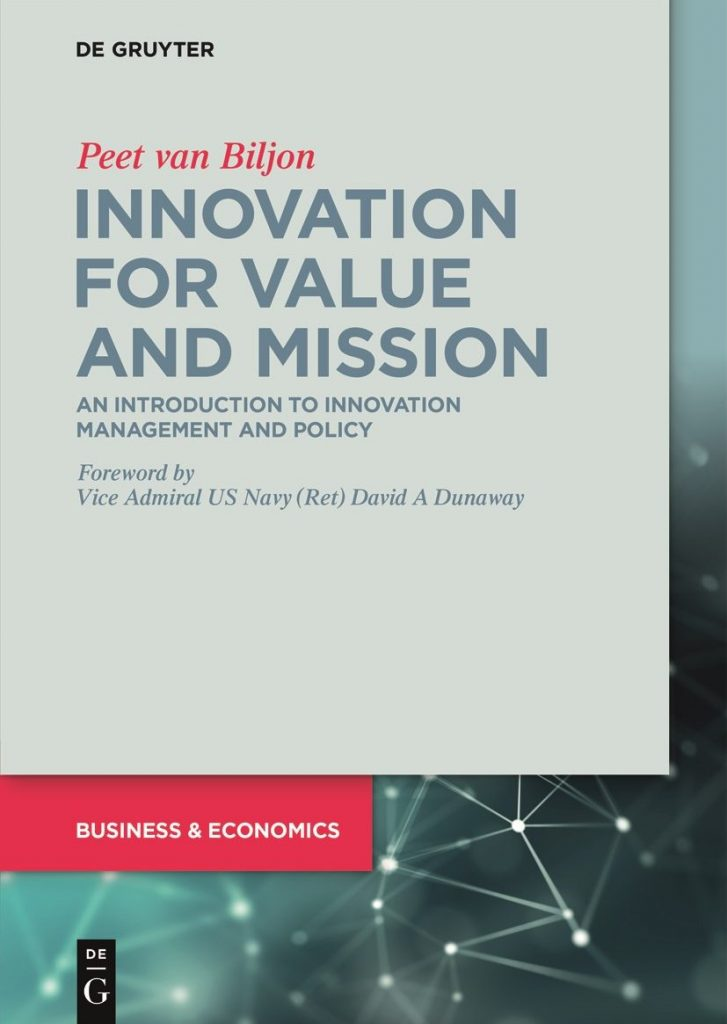
The course also forms the foundation for my textbook, Innovation for Value and Mission: An Introduction to Innovation Management and Policy, which was directly inspired by the content I developed when I created this course and expands substantially on many of its themes. It is not only a textbook, but a reference for practitioners too – I wrote it for myself and often use it as a desk reference!
One aspect of the course feels particularly timely this year. Student interest in artificial intelligence has risen markedly. That is hardly surprising. AI is no longer simply an emerging technology to be studied at some distance; most of us are using AI daily and it is becoming a major technological disruption unfolding around us in real time.
That creates an unusually rich environment for studying innovation. Students want to understand not only what AI can do, but how it may reshape industries, government, employment, skills, organizations, and society—and what public-policy responses may be appropriate. The course’s technology innovation research assignment explicitly asks students to examine a recent disruptive technology, assess its trajectory and use cases, and consider its implications for both government and commercial operators as well as policy makers and regulators.
For students of innovation and public policy, this is an extraordinary period in which to be asking these questions. The challenge is not merely to anticipate technological change, but to understand how we can continually manage and shape innovation so that it contributes to human welfare and prosperity.